
Where Magma Meets Desire, VI
The Gigantomachy of Our Times: Techno-Capitalism and the Foreclosure of Emergence

Introduction.
This article is the sixth and last instalment of our Magma Meets Desire series.
The first five parts have fully fleshed out our pluridialectical tool of historical interpretation, comparing and contrasting it with Hegel’s and Castoriadis’s visions of history, while using Lacan schema L read iteratively-collectively as an illuminating heuristic support. We already (parts III and V) briefly hinted at a post-1500 techno-capitalist system, which could progressively reduce, if not completely wipe out, the very possibilities of historical emergence.
Part VI, whose ambition is to provide the full schematic architecture of the series, will proceed as follows:
Section I will provide an adapted schematization of schema L in two movements: (1) the collective reading, understood as reflecting the dialectical relationship between autonomy and heteronomy, (2) the iterative (or historical) reading, which will show the mechanism by which historical emergence happens.
Section II will focus on the interpretation of the globalizing movement of the last five hundred years - the rise and continued expansion of techno-capitalism, beyond its western core - which we argued in the preceding parts was the overarching historical movement that could destabilize the very conditions of historical emergence.
Building on I and II, section III will fully articulate the globalizing movement, to be understood as a progressive unification of the symbolic order on a global scale, as well as the resulting impact on the subject and society as a whole, supported by an adapted schema L reflective of these movements.
Section IV will consider the meaning of the above evolutions, by arguing that the new global symbolic order is, in essence, an anti-imaginary akin to an anthropological illusion and a symbolic death.
I. Lacan schema L: a systematic historical reading.
For the original reading of Lacan schema L and my initial extension of it by way of an iterative-collective understanding in detail, I refer the reader to Parts I and II. I will here provide the illustrative mechanics of the ideas first deployed in the prior parts.
A. Reading schema L collectively: autonomy versus heteronomy.
The reasons advocated to read Lacan’s schema L collectively are: (1) if we are to consider the conscious individual a in his relation to the other person a’, then the same individual a’ has a similar relationship to a’’ etc. As such, the schema L a-a’ axis, applying to the individual, applies to everyone. (2) The A, or “Big Other”, representing the symbolic order, including institutions, language, and more, is, in its nature, the emanation of collective realizations, warrantying, in its turn, a collective interpretative reading.
What results is a set of logical questions, whose most important include:
a-a’: How variable is the a-a’ axis between individuals?
a-a’: How variable is the a-a’ axis within a single individual: a interacts with a’ but also with a’’ in a different way.
a-A: every individual has a different conscious relation to the Big Other A: more or less reverential towards institutions, more or less aware of them, more or less literate, too: a may know and understand more words than a’ and therefore her relationship to the chain of signifiers and the symbolic order is different.
A-S axis: how does the collective symbolic order and language impact the individual psyche (subconscious S)? Lacan believed myths molded the unconscious more than the other way around (part I).
These questions immediately raise one question, the question of the social. Inherently because of their collective nature of course, but also because they imply not only the differentiation between individuals, but invite the question of their stratification. Why?
i. a-A: homological valences. Individuals a, a’ etc. within a society have different - and unique - levels of education and intellectual conformation. Two levels are to consider, which I will describe as level and mastery.
Take two individuals: one particularly cultivated and another particularly ignorant. The cultivated individual will know more words, their meanings, and will also have a better, more comprehensive understanding of institutions, symbols, history etc. As such, their levels of understanding or access to Big Other A will be significantly different. Here resides an apparent paradox: Lacan reminds us that we are all trapped - more than we please to think - by language; it may appear the cultivated individual is at a disadvantage, being caught into a stronger linguistic straitjacket, which fixates an otherwise richer and more evasive reality: put simply, knowing more words may result in less “freedom”, not more.
But this is a primary illusion: for the individual knowing more words (and their meaning implicitly) is able to define, describe and even wield reality with more precision than someone with a more rudimentary lexicon: as such, linguistic diversity is a form of mastery: the ability to formulate ideas (and intentions) more precisely in the first instance, in itself a clear social advantage, but also the enhanced ability to “master” reality: surely, we are all trapped in language, but the absence of words paradoxically worsens the matter by increasing powerlessness. Indeed, the expression of my desires, aligning with Lacan, is firstly dependent on one’s ability to formulate them, and this formulation needs words, and a more precise formulation by way of linguistic precision results in higher performativity.
More: while I do not fully agree with Wittgenstein that there is no possible thinking without words, I largely concur with him that words represent a considerable - and virtually indispensable - part of it. In addition, a richer lexicon enables something else: richer thoughts, probably, but also the possibility to think - including critically, understood here as critical distance-taking toward the symbolic order itself, implying the ability to wield it, if not, in some cases, contributing to redefining it: mastery, then. If myths tend to mold the unconscious, the ability to take a critical distance towards them, for instance by understanding their intrinsic relativity, does help.
The social and psychological implications are momentous: an individual lacking words and concepts will somewhat passively suffer the symbolic order while the one excelling at it will be able to resist it more, if not controlling (and possibly manipulating) it. This obviously raises the question of the access to education and its quality, a prescriptive point to which we will return later.
For now, the social implications need to be further explored.
ii. A second trap: a’-S and the mimetic effect.
Let us take a group of individuals from the same hometown, of about the same age and the same social milieu. Their levels of education are similar as much as their worldview, implying, in schema L parlance, a relatively low variance of the a-A axis among them.
In their daily interactions (between a and a’, a’ and a’’, a’’ and a etc.), a will consciously influence a’ and the other way around. But, at a deeper level, the other a’ will also impact a’s subconscious, i.e. S, and, therefore, a’ relationship to A will act as a reinforcing loop onto a’s subconscious, i.e. S. As a result, individuals evolving within a given social milieu see their subconscious somehow cornered by double-tiered imposed representations: conscious interactions with people from the same milieus and of similar outlooks, but also a subconscious reverberation of such interactions onto the individual’s psyche.
One might say that this is a well-known phenomenon of mimetic reinforcement, adding a layer of subconscious. But the implications go beyond: if, in line with Castoriadis, the radical imaginary of the psyche resides in S, the relative saturation of S by self-reinforcing subconscious perceptions may significantly reduce the space for emergence, synonymous with originality. I do not believe this loop results in an absolute annihilation of the imaginary potential, but it may meaningfully curtail it under recursive social-psychological pressure. Preempting on the later section of this article, let us consider a possible prescriptive solution to it.
iii. Castoriadis and conscientization.
Castoriadis (see part II) actually evokes the need for conscientization in his social project, literally calling for human relations and a political project as least as possible loaded by the unconscious, but - and this is part of our wider critique of L’institution - Castoriadis remains mute as to its effective realization.
The answer seems rather close at hand though: is not education - the cumulative provision of words, meanings and context - the answer or at least a primary answer to a conscientization of the subject? By acquiring more words, ideas and interpretive tools, what the individual initially suffers (a cryptic and therefore almighty symbolic order) can be turned into - at least partial - mastery, evoking Castoriadis’s core and cherished idea of autonomy.
The irony of the “solution” I am proposing here is that it mirrors the therapeutic goals as well, which were Lacan’s initial intention when he forged schema L: for what is a therapeutic successful outcome if not the liberation of the conscious subject from her quasi-almighty, unchanneled subconscious drives, by way of - most of the time - verbal expression, and therefore the method of making the conscious emerge from the subconscious? As such, could the proverbial “putting words on one’s pain” be applied to a wider sociological remit, with education acting as the therapist?
Note to the reader: Castoriadis’s approach of the subconscious is the creative phantasies and the radical imaginary, which can be interpreted as a reservoir of creative potentialities. Lacan’s S is much more tragic in its etiology, the subconscious being the barred subject trapped by language and drawn by the spur of desire. While both approaches are radically different, I do not see them as mutually exclusive. Lacan approaches S as trapped by language while, therefore implying a constraining force of the symbolic order A onto S, while viewing desire as lack reflecting the subject’s split. But Castoriadis’s constructive-emergent view rings true as well: imagination and the faculty of representation are undeniable “positive” capabilities of the psyche emanating from the subconscious, and these can be used productively in individual, intersubjective, and collective manners.
Based on the above, let us sketch an adapted schema L which focuses on its collective understanding as we said, integrating its social dimensions, the role of education and the social milieu as well as the role of the imaginary in S, to emphasize its polarized dimension: autonomy vs heteronomy.
Schema L: a social reading - autonomy vs heteronomy
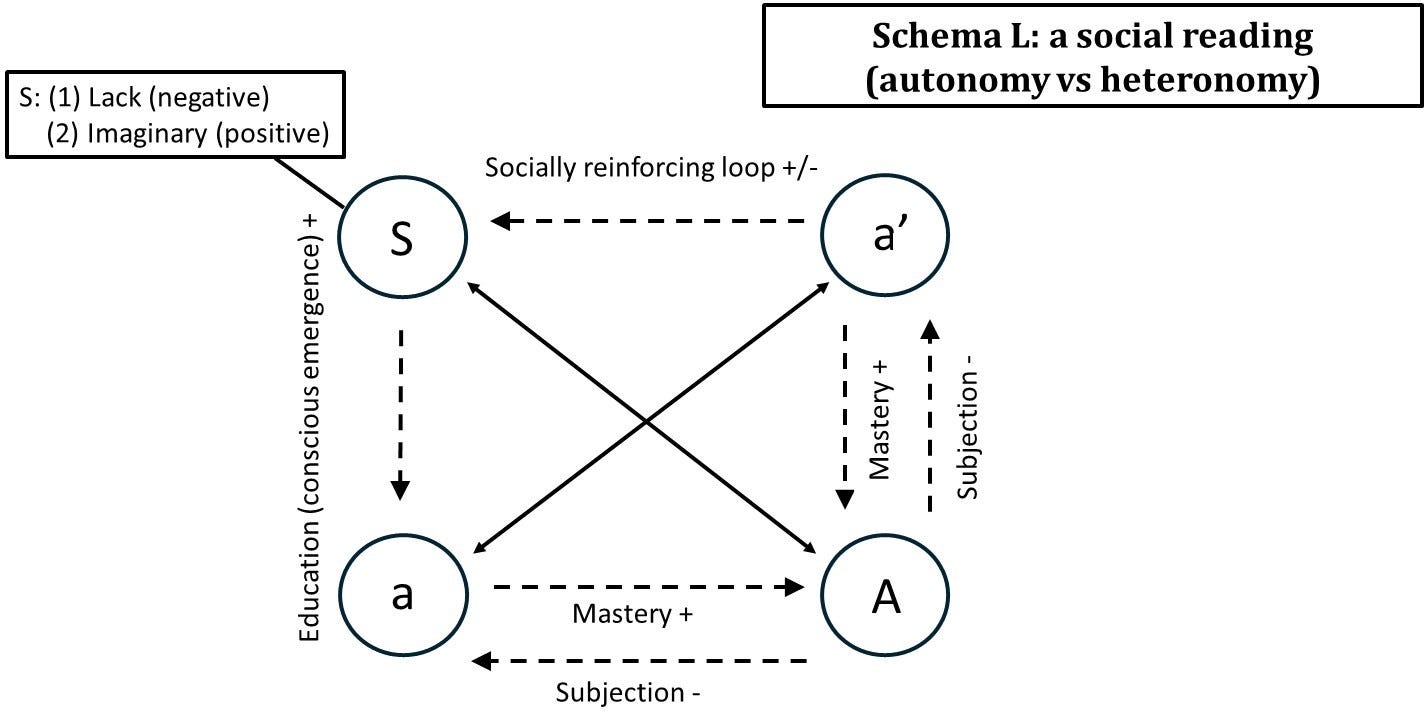
Terms and interpretation:
S is understood here in a double meaning (see note above): the seat of Lacanian lack, but also of Castoriadis’s radical imaginary;
+/- : the positive sign refers to what reinforces autonomy, while the negative sign reduced it;
The dotted arrows are the collective mechanics informing schema L;
What the schema illustrates is as follows: individual autonomy (and mastery) can increase by way of education, which elevates the level of consciousness, in turn rendering the subject better able to master his own relationship to the symbolic order. Note this naturally applies to both a and a’.
The socially reinforcing loop is ambivalent: interactions within the same milieu may reinforce (and therefore limit) the imaginary and conscious potential, however exposure to other social milieus or, put bluntly, more educated ones, will result in a reinforcement of autonomy.
The role of education: positive with caveats. It is often said nowadays that “knowledge is power”, and, in a way, this rings true. But this “power” I see as being a more particular form of autonomy, reflexivity and the ability to situate oneself in the world. A higher level of mastery is achieved because, in the first instance, it implies self-mastery, which education contributes to provide through effort, discipline and the acquisition of knowledge and a moral and intellectual conformation. Education, of course, is not the exclusive medium of empowerment, as family ties and parental education play an overarching role: however, education is probably the best vector of collective autonomy, i.e. the autonomy of all individuals considered in a society.
This assessment requires nuancing though: collective education (school, high school, university etc.) has been seen as heteronomous by many, who emphasize that the various schooling systems tend to confirm the “symbolic biases” of any society (nationalism, patriotism, religious bigotry, communism etc.) rather than emancipate the individual from them. I fully agree with these critiques, but the reason I am assigning a “+” to education is because, ultimately, even a modicum of education - however biased and imperfect - provides at least basic knowledge and instruments to evolve in the world. The second reason is because the current situation needs to be taken into account: in vast parts of the western world, education levels are eroding, and reading, for instance, is losing steam rapidly, largely due to the generalized and early adoption of smartphones, among others. Facing with a situation this grave, the question is therefore access to and mastery of basic literacy and arithmetic skills, before even considering the normative orientation of public education systems (a genuinely valid concern in itself). The latter, i.e. the capacity of the schooling and academic system to form more autonomous subjects, comes in a second movement.
The collective reading of schema L having been sketched, it is time to turn to its iterative reading.
B. Reading schema L iteratively: rigidity vs openness.
The collective reading of schema L helps focuses on the social dynamics and its resulting impact on individual autonomy vs heteronomy. The iterative reading focuses on historical dynamics, contrasting and highlighting the dynamics of stability vs change.
i. Methodological note.
The iterative reading of schema L is more complex than the collective reading, because it includes individual-collective dimensions but also chronological ruptures: an iterative reading therefore compels us to describe the mechanisms of historical change.
The second complexity resides in the multi-pronged nature of historical change itself. Our pluridialectics exposition showed that historical change is not only multi-causal, but morphologically extremely diverse. Capturing this polymorphous aspect along Lacanian and Castoriadian lines will require illustrative examples, provided at the end of this section.
In order to support our iterative reading, our findings regarding the collective reading itself will prove instrumental: our iterative analysis methodologically compounds with the earlier collective approach.
Lastly, given that most of the schema L has been reinterpreted alongside a collective (and implicitly iterative) approach, we will start this section with the initial schematization, which will show where Castoriadis’s relevant historical concepts and approach play a part, followed by important disambiguation, notably the conscious-subconscious respective roles.
ii. Iterative schema L: a visualized model of historical emergence.
For methodological reasons, we limit ourselves to human-type of historical or pluridialectical change (it would therefore exclude the Black Plague etc.), as their integration or incorporation within Schema L and Castoriadis’s historically interpretive tools appears as more derivative.
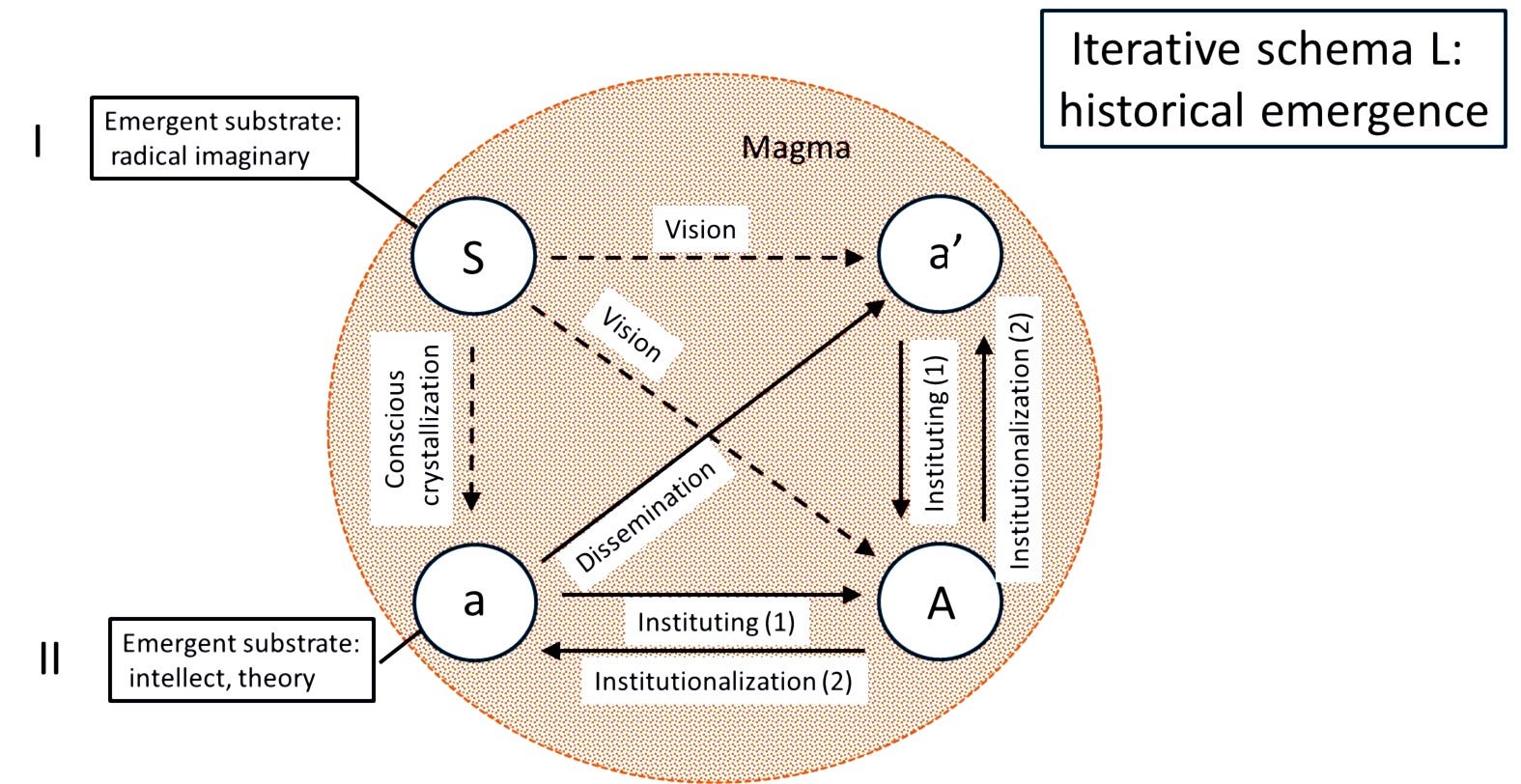
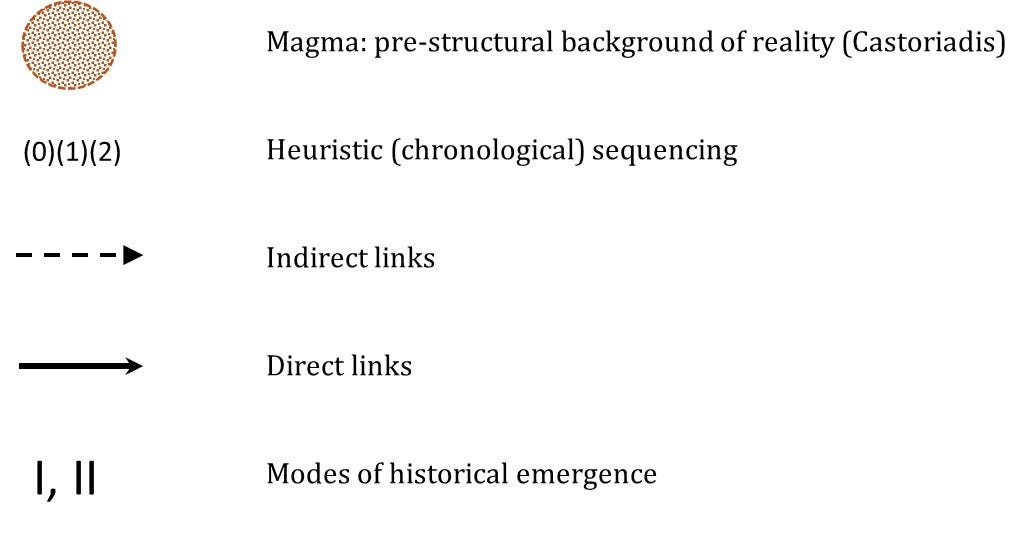
Terms and interpretation
Magma: see definition part II by Castoriadis. I need to add here some considerations regarding the word itself. Castoriadis chose magma because it lacks form and determinacy, illustrating the difficult-to-seize foundation of social-historical reality.
Sequencing: logical order in which historical change disseminates / spreads.
Indirect / direct links: heuristic distinction between simple and more complex causal effects
Modes of historical emergence: relative prominence of conscious vs unconscious
iii. Interpreting historical emergence in the light of schema L.
The schema invites the following reflections:
Magma: non-random randomness? As fundamental, moving background of the social-historical reality at any given time t, magma appear as reality in potential, that is what gives itself before its capture by the ensemblist-identitary logic1. A pre-conscientized environment, therefore, but which is not without incidence on history, as we show below: indeed, the world itself, including climate, vegetation, urban or rural environment, the ongoing social praxis act as potential ferment for emergent social innovations, and the question it invites is whether magmas, in their apparent randomness, do not provide some pre-conditions for certain historical changes to happen: this relates to our pluridialectical preparatory ground whereby, while non-deterministic, certain environmental and psychological factors might be ripe for certain types of emergence. Here, I would like to add two points about the word magma: etymologically, it comes from Greek μάγμα (kneaded mass, thick ointment), derived from the verb μάσσειν, to mix. The idea of a significant mass, whose content is mixed more than homogenous again illustrates the social-historical metaphor of indeterminacy. Geologically speaking, magma also presents interesting analogies with Castoriadis approach, as well as our integration of it within the schema L above: magma is geologically buoyant, that is, given its lighter mass than rock, tends to rise upwards. Another property is that its direction is influenced by pressure gradients whereby tectonic compression pushes magma through weak zones. Magma also follows fractures and faults, i.e., cracks, rifts and existing pathways in rock. This geological definition is particularly illuminating: (1) magma tends to erupt upwards, analogical to our notion of emergence, (2) magma tends to go to weak zones,, rifts, cracks and gaps: metaphorically, this is analogous to the half-random nature of pluridialectical events: while the exact direction of magma is unknown (and volcanologists would warn anyone off an erupting volcano, including themselves, due to magma’s partial directional unpredictability), it does seem to favor certain interstitial patterns. In our pluridialectical events, we saw that the preparatory ground included a similar notion: the Islamic expansion profited from a geopolitical void driven by Byzantine-Sassanian war exhaustion, as if prophetic emergence benefitted from a spatial-temporal hiatus. Jesus’s ministry happened in a remote and divided portion of the Roman empire, while the Black Plague found a world-changing outcome in the region of the world that was still relatively isolated from - and fairly marginal to - the Eurasian mass. While these analogies are obviously metaphorical, they should still draw our attention to the existence of social-historical and spatial fault lines that can contribute to historical emergence, while being non-deterministic.
Original emergence: radical imaginary turned vision. The seat of historical emergence resides, by excellence, in the individual’s imaginary, resulting in a new vision. This vision is oriented “towards” the symbolic order, or more precisely by envisioning a radically new order. The vision is also oriented to the other (small a’), but originally not alongside the “conscious” a-a’ axis of rational intersubjectivity, but by a communicative emanation which inspires others (akin to Max Weber’s charismatic influence, which appeals to deeper emotions and wonder rather than “rational” conviction), before a full crystallization or rationalization of the vision has been elaborated (one could think of the first followers of Jesus or Muhammad who felt attracted by their charisma, but did not initially know where they and the new vision were really going). The visionary dimension is fundamental: it gives the imaginary its ultimate goal. The very gap between the vision and the world as it stands at the moment of the original vision calls for action, acting as a catalyst of historical change: this is akin to Eric Voegelin’s remark that historical forms of Gnosticism - relentlessly keen on reconciliating the is-ought gap of social reality - acted as motor of historical change, albeit our appreciation is wider here: change does not only come from a willingness to change the state of things, but also to instate a new one, albeit both can partly overlap.
Modes of emergence: antique visions, modern ideologies? While the individual’s imaginary has played an evident role in history, the seat of historical emergence sometimes resides in the conscious individual, beyond his original vision or the resources of his imaginary, hinting at a subtle displacement of the seat of emergence from S to petit a. For instance, if we take revolutionaries like Sieyes or Lenin, they appear on the historical stage at a time when their vision has already sedimented into an elaborate philosophy or ideology, that is, after what I show in the schema above the conscious crystallization of an initial vision. This nuance is fraught because, obviously, the individual with a new radical imaginary is conscious, and likewise even accomplished ideologues are partly moved by their unconscious, but the nuance of modes of emergence I am establishing here, while primarily heuristic, does seem to point at a sheer historical nuance, too: in ancient times, prophets appeared frequently with visions (often from dreams, where the unconscious moves freely, Daniel and Muhammad come to mind) and many of such visions crystallized into changes in the symbolic order and historical change. This may also appear in non-religious figures like Alexander, whose vision of a new cosmopolitan Eurasian order appeared. In modern times, successful prophets seem to have virtually disappeared, and historical change is more frequently associated with ideological or nationalist revolutions: the characteristic of such revolutionaries (not only Danton or Trotsky, but also Mao, Simon Bolivar, Sayyid Qutb or the Algerian FLN) is that the change they called for was already highly intellectualized and sometimes even theorized (many of them wrote political manifestoes and sometimes even elaborate philosophies of action) when they became famous. As such, the conscious role seem to be much more prominent in driving their actions than an ex nihilo imaginary. Therefore, without oversimplifying, it may be that modes of historical emergence have slowly transitioned from a strong radical imaginary component to a deeply intellectualized one, echoing again our challenge of Castoriadis’s “constant” anthropological assumptions2, and, perhaps even more significantly (see below), hinting at the possibility that the tectonic background of the magma may also be changing.
Transition to stability: the homological back and forth. The sequential steps (0, 1, 2) illustrate the “direction” of historical change: as an individual (prophet, conqueror, scientist) or a group of persons (political group, revolutionaries) appear in history, they will start influencing, challenging, destabilizing, changing the symbolic order A: in essence, the movement of instituting. Once the symbolic order has been altered, the latter will, in return, impact the individuals living in the new society, reflecting the institutionalization of the newly instituted (these are sequential, not strictly chronological steps, as the institutionalization of the old continues to radiate for some time when the new instituting starts to emerge).
Dissemination as necessary catalyst. While a single person may challenge the symbolic order, its ultimate success (one of the tests for a pluridialectical event) will often require the cooperation of individuals who adhere to the new imaginary, and therefore the dissemination of the new imaginary alongside the a-a’ axis will be an intersubjective corollary and cooperator of the initial emergence. This is where the fully conscious intersubjective relationship plays its role, and, more substantially, questions or widen Lacan’s perception of our relationship with the other. For the interaction between say a prophet and his followers and that of the followers to their prophet in return (and their immediate successors), is, initially at least, not marked by the typical competitive rivalry marking most intersubjective relations (common understanding of the a-a’ axis), but by a true sharing in a new belief or a new cause, which appear as devoid of instrumental, manipulative, appropriative intentions, but focused on the striving for a fundamentally better world. As time passes by though, the generous impulse seems to be irremediably followed by internal strife (the case of the early caliphs following the death of Muhammad is historically striking, but the conflicts between Arians and Niceans or Mao’s and Lenin’s successors is virtually as eloquent).
The above schematizations have helped us elucidate the mechanisms of social-historical change. What appears is that a collective-iterative reading of schema L provides a stable tool of social-historical interpretation.
What also appeared though is that the components of the schema and particularly the relational dynamics between these terms are much more susceptible to change: echoing our Ellul-inspired critique of Castoriadis’s constant anthropology in part III, modernity seems to have impacted the modalities of emergence, among other things. Modernity, as we saw in part III, is predominantly characterized by the advent of Europe and later its north American offspring as hegemonic world powers, an expansion which was supported by Europe’s relentless scientific discoveries and technological innovations, while capitalism provided the material substrate and technique to accelerate this trend. Let us explore its modalities and implications.
II. Globalization: a flattened world?
A. Caveats.
The primary and secondary literature on modernity and its European colonial expansion avatar is too vast to cense. It is enough to observe that, post 1500, the western European powers progressively took control of an overwhelming portion of the known world, including its economic flows. It culminated in the late XIXth century, where the British Empire - the vastest ever - covered a surface more than four times superior to today’s China. While the independence movements after World War II ultimately put an end to it, the globalization trends actually did not recede, but accelerated: global institutions, fast increase of commercial exchanges and financial flows etc. The main opposite models, socialism and the somewhat ephemeral non-aligned countries, virtually disappeared after the fall of the Soviet Union and its east European satellites. The Chinese (socialist) and Indian (broadly non-aligned) giants, despite their size, cohesion, and relative resistance, have been increasingly integrated into the world economy, despite varying modalities.
Nowadays, there is a growing body of literature supporting the idea of a deglobalizing trend, which would, among others, see globalization turn into regionalization, notwithstanding more local fragmenting trends. I however believe this view to be partly flawed. If one is talking about raw geopolitical power relationships, many large countries remain outside the western orbit (Russia, China and India immediately come to mind), and, indeed, many countries actively reject western interference (Cuba, North Korea, Iran, Venezuela are the most publicized these days, but Liberia, Haiti or Afghanistan would probably foot the bill, too). But globalization is not limited to strategic considerations, and, in many other fields, its progress continues to be relentless.
B. The modalities of globalization: a sample.
Globalization should not be seen as a simplistic and reductive “imperialistic” or territorial project in the traditional sense. Globalization advances in multiple ways, a selection of which I am proposing below:
World institutions: the International Monetary Fund (IMF), the United Nations, the World Bank, UNESCO etc. continue to be global institutions wielding not only significant influence worldwide, but embodying the spirit of globalization, with virtually all countries - despite their differences and oppositions - being part of the global game.
English as lingua franca: despite an ongoing rhetorical discourse about the end of English as a predominant idiom worldwide, the English language continues to be spoken in vast parts of the world, including the most remote ones. Imperfectly, variably to be sure, but extremely vastly. It would be difficult to find countries where the personnel of say a hotel do not speak a modicum of English, which brings us to the next point. English can be seen as a major vector of globalization, more on this below.
Tourism: tourism is a very large industry and continues to expand. Passenger volumes, number of destinations and the infrastructure created around it play a significant role in dozens of countries, including the largest economic powers. Tourism fosters a form of cultural globalization, where people from very different cultures can directly interact, a fact that would have been inconceivable for most only a hundred years ago, and therefore contributing to a form of global convergence.
US dollar as means of exchange: again, despite talks of de-dollarization, the overwhelming majority of world commercial exchange is performed in US dollars, contributing to global unification, even when reluctantly. Buying vital necessities such as oil usually requires US dollar reserves, hinting at globalization and a form of economic dependence.
Law: international law reflects globalizing trends, supported by transnational courts (from human rights to business arbitration), where institutional seats are mostly located in the west (Geneva, the Hague etc.). “Qualitatively” speaking, the influence of US and English law is immense as well: not only are they used among major economic powers, but their influence is being felt even more because they have created unique legal constructs which determine how companies operate in the rest of the world. Legal technique, particularly in relation to business but not limited to it, impose a virtually unique framework in many aspects of law. Beyond the conceptual superstructure and the philosophy and interests underpinning it, global law is logistically supported by global law practices present in a majority of countries, and which further contribute to the constitution and praxis of a dominant legal idiom.
Technology: in this field as well, it would be hard to deny the sheer predominance of globalizing trends: who and which company (from the smallest to the largest) does not use Microsoft as operating system, Facebook and / or Instagram as social media, Whatsapp as messaging app internet browser or Firefox as ? Uber or Grab ride and delivery applications are as popular - if not more - in Asia than in western countries. The list goes on virtually endlessly, covering many sectors (LLMs, military equipment, automotive etc.).
C. Globalization: normative or programmatic?
The telling list in ii. above (which is far from exhaustive), invites the following structural observations:
The color of globalization: our examples above, underpinned by a longer term historical trend of “westernization”, show that globalization, its origin and nodal centers come from and are predominantly located in the western world. Tourism, business law or social media are eminently western inventions and, in turn, seem to serve western interests: travel companies’ income, multinational corporations legal and fiscal agility, the vast amount of personal data collected by technological companies, all converging towards significant economic interests. As a result, while many aspects of globalization appear as normatively inspired because they rely on western norms and ethical values (human rights, democracy, international law etc.), such normativity seems to act as a folding screen for much more practical interests. This, in itself, is not historically new. A great deal of past regimes have justified their domination with a varnish of ethical, religious or ideological legitimacy, and the global western avatar can safely be seen as an umpteenth - if particularly sophisticated - iteration of the same principle. Where things diverge though is in their implications for historical emergence: globalization is not global, but essentially western. Consequently, globalization is unidimensional in nature, originating in and reflective of a single model when taken as a whole (including the internal contradictions within this system). Which brings us to the second point:
Globalization, legein and teukhein. A monopolized praxis? We evoked English as unifying lingua franca in today’s world. However, the increasing prevalence of English is just a linguistic instantiation of globalization, not dissimilar to French in post-Renaissance Europe or Latin in the Roman empire. Where things appear as more consequential is the imposition of a new “language” in various fields of human activity (politics, law, business, finance, sciences, technology etc.), going from linguistics to semantics: the proliferation of (mostly English) technical terms in so many fields of human activity progressively impose new categories, ultimately crystallizing in an entire worldview. These “new” words and notions find their historical origin in the new praxis developed by western powers as their territorial expansion and technological advancements progressed: In Castoriadis’s terms, the new legein reflects the new teukhein, and, in return, the spreading of the new legein in all fields of activity increasingly pervades the global symbolic order, which, in turn, influence the teukhein further, which proceeds from the new legein categories: the global social praxis is therefore increasingly converging, in a spiral-like movement, towards an increasingly monopolistic, and therefore increasingly less diverse, praxis. Two objections might be leveled here: the mechanism of praxis monopolization is not new (past empires and kingdoms justified their power with new ideological parlance and symbols, resulting in power-inflected praxis) and there is nowadays genuine efforts of resistance against a western-inflected globalized praxis. My answer to these is combined: the novelty of the global situation is its potential for covering the entire oikumene, potentially stifling alternatives if it continues to progress. Secondly, the resistance shown is rather thin: one might finance a shariah-compliant transaction in the Middle East, but such transactions represent but a negligible portion of global financial flows. Various nations continue to retain strong idiosyncratic cultural differentiations, starting with local idioms, but the combined corrosive aspects of technology usage, western cultural influence and economic-geopolitical dependence can hardly be ignored, not only economically or geopolitically, but, at a deeper level, anthropologically. But, more significantly, such resistance predominantly uses the same technical idiom: if Coupang replaces Amazon in South Korea or if Chinese Tik Tok competes with Instagram, all are still participating of the same praxis movement: they may partly ward off global economic monopolies (not a negligible fact in itself) but they still participate of the same - western-inspired - social-historical logic, and, therefore, imaginary, reinforcing its semantic-praxis layer further.
The above considerations have shown the following: whether globalization is western-centric or western-original (which it is) is beyond the structural point. Whatever its color, the unification of global praxis is what is at play, at an anthropological level, past geopolitical interests, economic considerations, or even “cultural” rivalry.
A double movement therefore seems to appear from a schema L perspective:
(1) Horizontally, the singularization of schema L, understood as the transition from plural, largely independent idiosyncratic societal models into an increasingly global, and unidimensional one;
(2) Dynamically, an alteration of the Schema L libidinal mechanics themselves.
These two movements are simultaneous, resulting in a complex and homological historical - and potentially future - trajectory which requires clarification as to its exact unfolding. Lacan schema L will provide a most useful analytical tool to that effect.
III. The Techno-Capitalist System and Schema L: From Symbolic Convergence to Libidinal Absorption.
A. From schemas L to schema L: the horizontal reduction of the symbolic order.
i. A relentless homogenization.
At a simple level, we can see globalization as a progressive movement of unification of different societies into an increasingly global one. This perspective is no phantasy or exaggeration, as long as it is understood specifically: the medium of globalization is western techno-capitalism, which progressively coerced a variety of cultures and polities to abide by its commandments: while many cultures instinctively resisted a potential integration into the world system (see part IV on Ming-Qin China and Tokugawa Japan, other examples obviously abound), the globalizing trend caught up with them, leaving very few exceptions.
Despite conscious - and often effective - rejections of a globalization perceived as western imperialism, time seems to have relentlessly corroded such resistances, as to render them seemingly futile: where military coercion did not work, the combined economic and technological pressure won the day. And, indeed, what is technological progress if not an arm’s race? The imperious necessity of not being left too far behind technologically and economically (which go together) ultimately left many post-colonial societies forced to adopt, willy-nilly, many of the western technologies, codes and representations they originally and instinctively so vehemently abhorred.
In a rather tragic historical twist of irony, the very states and societies that still resist any form of global patronage are qualified - by western powers at least - as failed or rogue states, which, to an extent, they are. But this spectacular outcome begs the question of whether a nation, or a society, can today survive without a minimal level of integration in the wider economic system? Back to our original concerns, is not only historical emergence, but even independent survival, not fundamentally impaired outside the globalizing order?
ii. Horizontalization: schematization.
Let us provide an illustration of what we said just above, namely the progressive horizontalization of the world, whereas local differences where originally idiosyncratic kosmoi koinoi become increasingly infiltrated by transcultural elements.
We saw that globalization primarily affect legein and teukhein, by propelling a new global idiom, which is not so much linguistic as semantic, and therefore primarily impacting Lacan symbolic order. Given the complexity of interaction between global history and its impact on schema L, let us focus on its most obvious dimension, that of the transformation of the Big Other A, which encompasses language, values, institutions etc.
Schema: the globalization of the symbolic order.
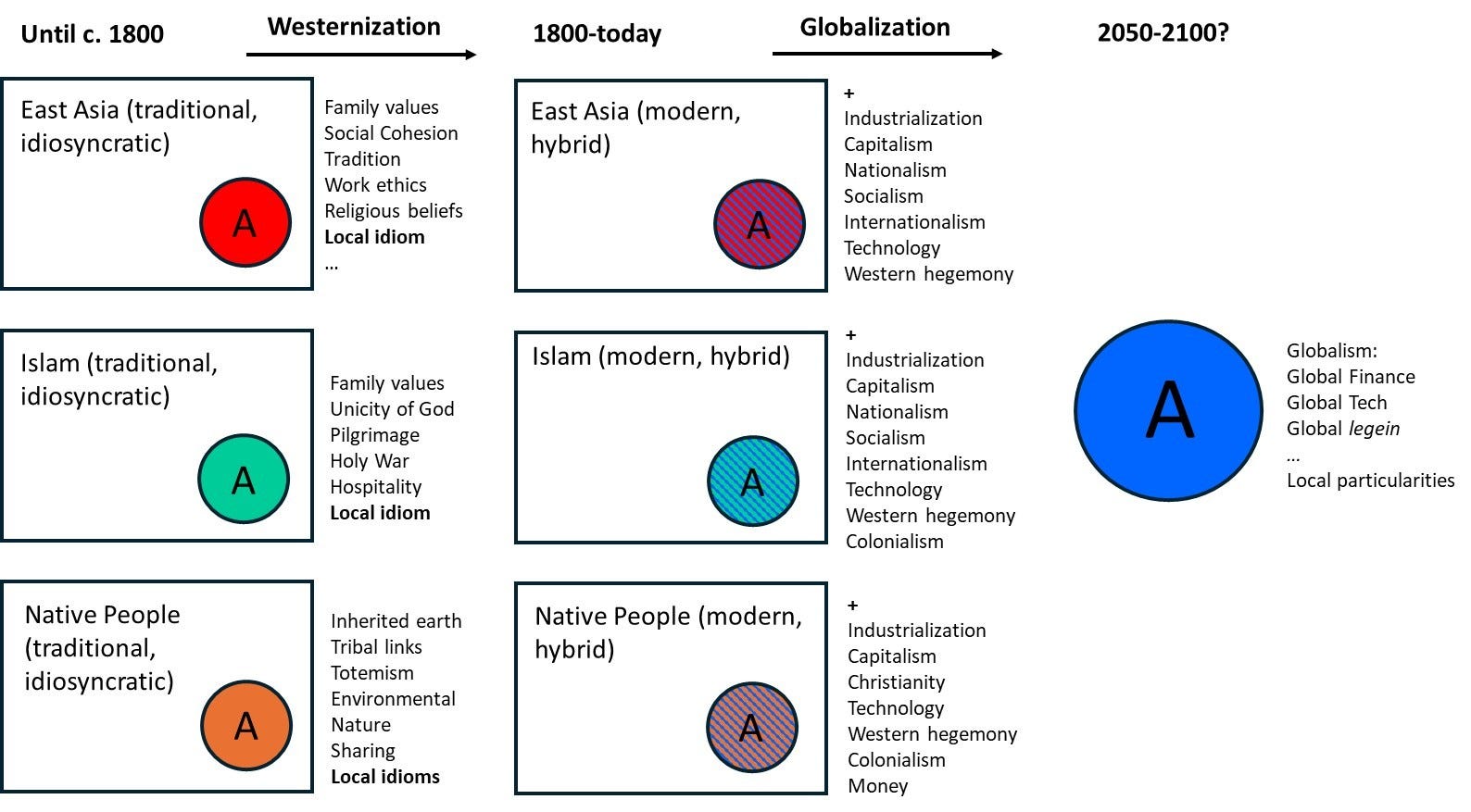
a) Presentation
The schema above illustrates the impact of westernization-turned-globalization on the symbolic orders of various world societies and cultures over time, more particularly from the pre-modern to the global order.
b) Chronological sequencing
There are three historical periods: pre-modern, i.e. before 1500 and the beginning of European colonial expansion, when local cultures are virtually untouched by western influence, the modern period, with westernization accelerating from 1800 (the 1500-1800 period being implicitly understood as a proto-westernization before the full-scale imperial expansion post 1800) up until today, and the coming century, which could see the accomplishment of globalization.
c) Sampling
We have taken three broad types of non-western societies: the east Asian, Confucian societies (China, Japan, Korean peninsula, parts of South East Asia), Islam (its Arabic center then Turkish, Persian Central Asian extensions), and native societies (Native Americans, Aborigines etc.). The idea is to show that despite their radical differences, they all have progressively converged towards globalization.
d) Schema L relevance
We read the schema L collectively. One of the two reason being that the symbolic order is eminently collective. But each society has its own symbolic order. Therefore there is one schema L per “society”. I adopt here a perimeter that covers entire cultural eras, but sub-schema Ls (essentially, nations) could be envisaged and modelized of course, being part of a wider cultural area.
As such, I am focusing here on the Big Other A element of schema L. The reason is of course that, as we said above, this is where the globalizing movement hits more obviously, by progressively changing the praxis oof entire societies.
e) Interpretation.
i) The starting point (pre-1500): local kosmoi koinoi.
Each society or culture has an individual symbolic order, which specifies its very identity.
As shown in the schema, traditional Islamic societies are strongly impregnated by a strong sense of monotheistic beliefs and afferent religious traditions which play a considerable role in their imaginary. We have mentioned pilgrimage or holy wars of conquest and conversion as some obvious examples, as they have and continue to inform the ethical vision of these societies.
Confucian societies are traditionally seen as societies marked by a sense of harmony (Chinese Yin Yang, Japanese Wa (和) or social harmony, etc.), strong hierarchy and family values etc.
Native societies also display similar symbolic references and beliefs such as shamanism, totemism, and a deep sense of man’s integration - and deference - to the physical environment: not only can natural sites be “deified”, but the awareness that the children inherit the earth their parents leave is fundamental, hinting at a resolutely non-instrumental view of the world.
ii. Westernization phase (1500-1800, first encounters, consolidation-acceleration thereafter): the infiltration of local symbolic orders.
This historical phase is characterized by a deep penetration of local societies by European civilization writ large, which triggered increasing changes in the various local symbolic orders.
East Asian societies have been deeply influenced by modernization, and ultimately embraced western-inspired technologies. Ideologies, the eminently political component of the symbolic order, have had significant influence: ideas, ideals and ideologies such as socialism, communism, democracy, constitutionalism etc. have fundamentally altered the symbolic landscape of these societies in the last two centuries, under the aegis of a strong globalizing movement: the case of China is particularly striking: the ancestral (multi-millenial) imperial tradition ended in 1911 after the regime change imposed by Sun Yat Sen’s nationalism (a European ideology), followed by a further “westernization” - in its Marxist variant - in 1949, with Mao Zedong’s takeover, followed by a third layer of westernization after Deng Xioping reforms post 1979, which transformed China into a major capitalist power, beyond its socialist garble. This striking example shows that the globalizing movement is not so much a matter of normative orientation (right-wing or left-wing) but betrays a structural change of the symbolic landscape as a whole.
Islamic societies have also experienced the impact of European civilization in an unprecedented way: technologies have been increasingly imposed or adopted, but ideologies such as socialism (their Baathist Syro-Egyptian variants), nationalism etc. have made their mark on the symbolic order in a spectacular fashion: think of Ataturk’s Turkey giving up on the ancestral institution of the Islamic caliphate (1923) and adopting the Latin script to replace the Arabic one, while embracing a European type of nationalism (similar to China, Japan, Singapore and many others).
Native societies, while they followed a different path of westernization, nonetheless exhibited the same levels of western infiltration: integration-absorption within wider nations from a legal and administrative standpoint, the progressive geographic curtailment of their physical environment, increasingly the target of capitalist and technological exploitation (Amazon forest, underground resources, etc.). While money was virtually absent from these societies, they have become indispensable today for their very survival: the example of Native American casinos provides an eloquent illustration, albeit being a single component of a much wider movement.
iii. Globalization (present-forward): Big Other A globalized?
The decades to come will show how this progressive convergence of local symbolic orders towards new western-inspired categories and language will lead to.
The schema shows a simplified and absolute convergence towards a singular, global symbolic order A: not only a Big Other, but a globalized one. The future is never certain, but this outcome, based on the accelerating trend observed in the last five centuries appears as an increasingly probable outcome.
f) Implications.
The movement of westernization-globalization and its impact on local symbolic orders over time appears as extremely diverse: ideological, linguistic, economic, technological, cultural etc. Which begs the question: is there some form of higher-order interpretation of this phenomenon? If it is a movement of westernization-globalization, is there and what is its ultimate meaning?
If we look at the initial stages of westernization, namely colonial expansion, exploitation, territorial acquisitions, or even Christianization, one might say that they can all be subsumed under a logic of power, primarily economic and political, a fundamentally appropriative logic; indeed, this would be a fair summary of European colonialism-imperialism in its simplest form and logic. Victorian or French colonial endeavors might have been genuinely experienced by their protagonists - in more or less good faith - as genuine advancements of the human condition, by providing entire populations with the commodities of the modern world or new cognitive horizons. Despite bouts of sincerity here and there, such ethical vestments remained secondary factors compared to the more brutal logic of acquisition-expansion.
But there is more, namely a second morphological movement which appears as time advances: the proliferation of western ideas, categories and representations look, for most of them, increasingly short-lived. The Chinese example above, where a millenary civilization goes from traditional imperialism to nationalism, communism then capitalism in less than three generations hints at a form of often over-glossed acceleration of history: it looks like the changes at play are so rapid that they fail to find any durable concretion in the symbolic order, the latter becoming so saturated with new elements that it may become increasingly less readable, i.e. fundamentally confusing; one might genuinely ask: is today’s China Marxist, capitalist, nationalist, corporatist, Confucian? And reply that it is probably a composite of all. What applies to China applies to other countries. An element of symbolic saturation seems to become visible in many countries: after thirteen centuries of relatively stable dynastic successions, France experienced with revolutionary constitutionalism, a directorate, an empire, a monarchical restauration, a second empire, a second, third, fourth and fifth Republic, not accounting for the German occupation. The same question applies: is France socialist, liberal, Christian, secular, capitalist?
As a result, can we find unifying factors in our movement of westernization-globalization and their symbolic order resonance that endure the test of time? And, as direct corollary, does it imply a form of pecking order could structure - and hierarchize - the symbolic order itself?
The third section or step of our schema above provides a contemporary answer: despite a proliferation of ideologies, political movements, attempts at new societies in the last two hundred years, techno-capitalism appears as the most enduring, across all geographies, and virtually the entire world relentlessly converges towards it. And the proof is in the duration: it is not only that the techno-capitalist progression advanced under the - more or less sincere, more or less conscious - guise of various ideological, philosophical or ethical vestments, but also that techno-capitalism, by progressively consolidating its clout on the symbolic order, increasingly corrodes not only the legitimacy, but the very credibility, and ultimately meaning, of any competing axiological categories: the literal exotification of creeds.
This latent and increasing jadedness of the people towards ideals links to the critiques of postmodernity, who either called for a post-ideological world, or even declared it already accomplished. Not only the imperium of relativism, but symbolic liquefaction. The literature on this (Lyotard, Derrida, Zygmunt Bauman etc.) is too vast to mention but Castoriadis himself was attentive to this deeply worrying movement of creedal senescence (my translation, emphases are mine): “In the crisis and the contestation of social forms of life by our contemporaries, there are particularly load-bearing facts: the erosion of authority, the gradual exhaustion of economic motivations, the attenuation of the influence of the instituted imaginary, the non-acceptation of rules simply inherited or received, that one can only organize around one or two central points: either a form of progressive decomposition of the content of historical life, of the gradual emergence of a society that would broadly speaking be the exteriority of men vis-a-vis other men, and of each to herself, an overcrowded desert, a solitary crowd, not even anymore an air-conditioned nightmare, but a general anaesthesia.3”
Indeed, Castoriadis’s puzzlement may find answers in what we said above: is the crisis of authority (understood here as an authority that is perceived as legitimate, not autocratic, partial or arbitrary) not the result of a disaffection with ideals, increasingly seen by the population as too short-lived, relative, and somewhat dishonest, in that they are viewed as increasingly transparent moral vestments of particular interests? And, as a result, what Castoriadis calls the attenuation of the power of instituted imaginary finds its answer, too: have institutions (in their wider understanding, symbolic more than administrative) not been progressively discredited by their lack of rootedness in firmer, longer-standing ideals, resulting in a growing creedal apathy (“anaesthesia”)?
If so, the acceleration of history we alluded to has not only led to a possible anthropological saturation of the symbolic order(s) (too many signifiers, too ephemeral) but ultimately to its drastic impoverishment: if symbols lose their meanings due to their excessively short-lived nature, then the symbolic order is losing anthropological grip, a possible first in human history.
To recapitulate, the rampant symbolic proliferation of the last two to five centuries has led to a quantitative and qualitative change: a multiplication of symbols leading to moral disorientation and instability, given their lack of anchoring in a lived past. Ataturk’s erasure of the Arabic script rendered Ottoman texts inaccessible to the next generation, new ideas replace the old ones etc. As historical forces converge towards technique and money, the alternatives are losing steam, leading to a uni-dimensionalization of the symbolic order and man in return: the global techno-capitalist-inspired big other A appears a s clear winner: money and technique, as endless recursive goals (under the guise of progress and advancement) increasingly deprive the old instituted imaginaries (symbolic order) of their vitality. And the techno-capitalist architecture is supported by its own legein (techno-financial parlance: GDP, smartphones, internet, “connectivity”, “innovation”, bitcoin, blockchain, “social” media, “value creation” or the strangely eponymous “Fintech” coinage, the list is virtually endless), which pervades social life way beyond its original remit: nowadays, a growing number of universities - including top tier ones - are closing their humanities departments. Not only do such moves betray the overarching economic logic underpinning it (playwright, historian or philosophy lecturer are not the best paying jobs), but such - eminently reductive - decisions are supported by a discourse whose very terms are informed by managerial, more than academic parlance: the cursus becomes a portfolio. And one manages a portfolio: legein and teukhein homologically converge. In simple words, both means and ends converge: if economic productivity and efficiency are earmarked as the end goals, the very mechanism by which these ends will be achieved will reflect the same logic, and therefore language.
Summary: the historical convergence of the traditional symbolic order towards an increasingly unified and unidimensional one has been exposed. It immediately appears that this globalization-reduction of the symbolic order is not without impact on the wider schema L, for if the symbolic order is being so fundamentally altered, its impacts on the subject (conscious and unconscious) are inevitable. In addition, as we saw in the implications section above, the legein / teukhein cannot remain untouched by such a transformation, implying that the very social substrate on which society reposes, or praxis, has already been modified by historical change, but is increasingly directed by the rearrangement of the symbolic order, in an homological movement.
We therefore need to address how the unfolding historical mutations exposed above reverberate on the broader economics of schema L.
B. Techno-capitalism and schema L: the full articulation.
Paragraph A. above enable us to focus on the effects of techno-capitalist globalization on the symbolic order and language, or Big Other A, resulting in both a convergence and reduction of different instituted imaginaries into a global(ized) one where money and technique appear as paramount, with local residues left to a participatory role at best.
Let us now zoom out and consider the implication of techno-capitalist globalization on the wider schema itself, by focusing on its components and relational dynamics, where it will appear a whole new schema L economics is arising as a result.
i. Petit a in a global world.
The intuitively easiest starting point is petit a, or the conscious subject. The analysis of globalization above immediately begs the question of its sociological impact on the subject. What is it to live in a global world for the conscious individual?
The immersion of a in a global techno-capitalist system provides the social-historical context in which he evolves. As the symbolic order converges hierarchically towards technological and chrematistic representations, his actions and praxis, are increasingly influenced by it. There is no escaping one’s social-economic environment: as we saw above, even remote regions of the world are increasingly captured by global economic flows: local access to resources like fuel or electricity imply a much wider integration into the world economy and technology.
Petit a is therefore constrained to act accordingly. There might be variances in terms of the level of economic autonomy the subject can achieve, but a full disconnection from wider economic systems (national, regional and global) appears as increasingly less plausible, and this is true - with different modalities - for a Khirgiz shepherd or a Japanese high net worth individual. In practice, petit a concerns will increasingly converge towards materialistic pursuits, not always out of conscious choice, but because of their necessity: access to basic resources such as water or food will most of the time require cash (currency): even a local, “independent” food producer in the south of Kenya, who inherits a family home, will need access to telecommunications (weather forecasts), transportation (selling goods out to town etc.), all which require a modicum of integration in the much wider economic-technological system.
These constraints, nowadays, are becoming particularly acute for a large percentage of the world population, including (and maybe even more) OECD countries, where even property ownership is far from guaranteed. The whole converges towards a form of livelihood pressure, resulting in a concentration of the subject’s efforts towards economic pursuits increasingly exclusively. This obviously poses the wider question of economic justice and the staggering global inequalities (within and between countries), which are widely documented in contemporary literature. But my point here is structural: in traditional societies, networks of local solidarity, family ties etc. were paramount, and somewhat alleviated the economic pressure on individuals by way of economic disintermediation: family and friends would help without asking money in return for the service provided (they might expect a favor in return, but again, likely to be economically disintermediated).
The rampant globalization has however eroded these structures by (1) progressively pervading them with external elements (economic and technological in essence, but also cultural and representational as we said), and, as a result (2) corroding the background on which they reposed: the monetization of the economy, combined with rampant urbanization (technological effect) led to, for instance, rural communities losing their youth who need to “find a job” in town, a phenomenon that started in the European countryside of the early Industrial Revolution, and has spread across the world ever since.
In other words, the long globalization has resulted in a fundamental reconfiguration of human activities along techno-economic lines, modifying both petit s’s symbolic order and praxis, in a homological, and therefore self-reinforcing, movement: as local praxis is eroded by new economic networks and technologies, the collective imaginary increasingly focuses towards economic and technical pursuits, which in turn reinforce this new techno-economic praxis further, as the mental referential points drive, if not coerce, individual action correspondingly.
These remarks invite to consider the globalized petit a’s relationship vis-a-vis others, along schema L a-a’ axis.
ii. a-a’ in a globalizing world: a cathectic reorientation.
It is important to disambiguate one thing up-front here: namely Lacan and Castoriadis focus on the a-a’ axis, i.e. intersubjective relationships.
For Lacan, the a-a’ relationship is essentially characterized by rivalry, competition, and a form of appropriative relationship, a competition of egos of sorts. Castoriadis, in return, while not denying these dimensions (see parts II and III), also emphasizes the opposite pole of solidarity, cooperation, and genuine encounter with the other.
I believe Castoriadis’s complementary approach to be the right one: we saw above in our prophetic examples that genuine cooperation, devoid of personal interests, could and did exist historically, and is probably a fundamental component of the texture of any society’s life. Ignoring it or focusing on its appropriative aspects a la Hobbes looks like a first order anthropological reductivism.
However, the globalization movement, once again, challenges Castoriadis’s hopes: with petit a (and therefore, petit a’, a’’ etc. as we said) increasingly pressured by economic immediacy an technological occupation (more on this below) and the individualization-atomization resulting from it, the very morphology of the a-a’ axis is impacted as a result: the progressive dissolution of ancient solidarities, perennial communities etc. cannot remain without impact on interpersonal relationships, which are increasingly marked by the seal of techno-economic efficiency: atomized (there is an explosion of celibacy and divorces in large metropoles today, compounding with plummeting birth rates) individuals in large urban centers can recreate local solidarities, but they have to start from scratch with, most of the time, perfect strangers.
As a result, many basic social interactions become economically intermediated. Repairing the bathroom requires a plumber, food is not produced but bought, transportation (bar short walking distances) will require money etc. Ellul’s perception of mankind’s progressive entrapment in a technician system rings true. And the interaction with a’ and the wider world is increasingly marked by monetary and technological intermediation. If we add the economic livelihood pressure mentioned above, not only are relationships increasingly inflected by economic and technological factors, but also by rivalry: within a professional remit, compare the “organic” nature of the relations between members of an XVIIIth century guild and a large or even multinational corporation today: in the first, life commitment to a vocation, transmission of knowledge from master to companion, solidarity networks within and between guilds (Ogilvie), job for life, and, in the other, reckless competition, office politics, risks of job loss at every economic cycle (or technological “innovation”, often used as cover for cost reductions etc.). The instantiation of a-a’, two or three centuries later, is hardly recognizable4.
As a result, the impact of techno-capitalist globalization on the a-a’ axis appears as an increasing cathexis on the rivalry pole of it, to the detriment of its cooperative one. If a-a’ can be seen as an eminent component of social praxis, then what we said above results in a significant inflection of the meaning of human relationships as a whole: similar to the progressive reduction of the symbolic order, intersubjective relationships are no less affected by a progressive reduction, but also mechanization of I-Thou rapports, under techno-economic pressure and rivalry.
Now that the dynamics of globalization have been described for A, a, and the a-a’ axis, it is time to bring our focus on to S, the unconscious subject, the seat of desire (Lacan) and radical imaginary (Castoriadis).
iii. S and techno-capitalism: can the radical imaginary be radically absorbed?
Tackling the unconscious is always fraught. Psychoanalysis has “discovered” and formalized the idea, but the very nature of subconscious - ineffable, unseizable, a-logical - resists any easy capture (see part II).
In order to provide as clear an interpretation as possible, I will define its scope as precisely as possible.
Firstly, as I pointed out above, there is a slight nuance between unconscious and subconscious. Both Lacan and Castoriadis the earlier, but I am more attentive to the latter: unconscious reflects the idea of a compound which opposes consciousness, and is devoid of it: there is no reflexivity of the unconscious. The subconscious, though, seems interpretatively more fruitful, for its sub- prefix, is both less atopic and more directional: the idea that, ultimately, subconscious emerges to the conscious, albeit its modalities are difficult to pin down.
Secondly, the unconscious is polyvalent: it is the seat of desire and ontological lack, an essential, constant but also diffuse emanation of the psyche, giving it a somewhat ethereal color. But, likewise, it is also the seat of dreams and radical (that is, non-combinatory) representations. I align here with Castoriadis and his attentiveness to both dimensions, which is worth quoting here (my translation and emphases): “It is not possible to understand the problem of representation if one looks for the origin of this representation outside itself. The psyche is, indeed, the “receptivity of impulsions”, a capacity-to-be-affected-by, …, but it is also (…) the emergence of representation as an irreducible mode of being and organization of something in and by its figuration, its “imagination” [“mise en image”]. Human psyche is a forming which is only in and by which it forms and as it forms; it is Bildung and Einbildung - formation and imagination, it is radical imagination which already makes a “first” representation from a representational nothing, that is, from nothing.”5
This passage is fundamental to elucidate the role of S in Lacan schema L read collectively. The imaginary of S is productive as much as representational and forming, which however does not exclude its capacity to be affected by the wider world. Castoriadis, adopts a phenomenological view of the subconscious, in a reverse way: while phenomenology is particularly attentive to how things appear to our senses and consciousness, the subconscious reverberations (and its capacity to be affected by) are often less approached. More, Castoriadis’s view of the subconscious role hints at his wider homological logic: the subconscious is both affected and “affecting”.
Two movements therefore appear within S, in a push-and-pull type of analogy: “productive” emergence and diffuse attraction. The question therefore becomes: how does the techno-capitalist praxis and imaginary impact S?
The techno-capitalist system, its symbolism and praxis, pervade the social-historical environment. The very means by which it proliferates are well documented, and technique appears as paramount here: in the last decades, the usage of devices such as computers, connected TVs and smartphones has exploded, in virtually all regions of the world. The time spent by individuals on their screens - even excluding work occupations - amounts to several hours a day: social media, news and online shopping occupy a prominent place. The (negative) cognitive impacts are documented by a growing amount of empirical research (see our AI series, part II and V for further detail) but let me first look at the content before the medium:
(1) social media refer to the a-a’ axis: social media are known for a few characteristics: competitive rivalry, in the form of competing for who has the most interesting life, is obviously one of them. Social media embody our cathectic movement in the paragraph above.
(2) News, often from very large, global media outlets proceed from the symbolic order and its representations: economics, politics, geopolitics and technology constitute a vast share of its content, reinforcing the globalizing legein we spoke of above.
(3) Online shopping is obviously the economic avatar: look for the best buying opportunity, comparing prices, finding the next best hotel.
What appears from this short description is that the new technology of “communication” acts as medium of the new symbolic order. But this technique can hardly be reduced to a simple means. Why?
The impact of technological usage on the human psyche cannot be ignored: it of course alters cognitive capabilities (less ability to concentrate, resulting in decreasing reading habits etc.) and behaviors-praxis (interacting with others by way of technological intermediation, like messages or video calls) but also participates of a growing colonization of the imaginary. The relentless bombardment of ephemeral news, memes seems to maintain individuals in a perpetual state of anxiety, itself conducive of lost contemplative time. Such critiques have already been elaborated eloquently elsewhere, but the finer point here is the impact it can have on the individual’s imaginary capacities. Many inventors, writers and artists said that many of their best findings arose not in moments of business, but in half-conscious or contemplative states, which links to our subconscious-conscious emergence: in another article, I mentioned the mathematician Poincare’s reflections on the matter, where he tried to pinpoint “where” mathematical discoveries appeared, and came to the conclusion that such findings were the sudden crystallization of a long, semi-conscious gestation.
If we are to agree with Poincare and our findings, the constant technological cognitive demand on the human psyche leads to an erosion of the very conditions of the creative imaginary capabilities themselves: (1) the human psyche is “informed” by external representations, themselves increasingly unidimensional and ephemeral in their content (adding disorientation to impoverishment) and (2) the very space - or time - where the subconscious can productively work, that is, sleeping time, including dreams, is increasingly dented into by nocturnal smartphone usage (which is now bordering on a public safety concern).
Castoriadis (who passed away in 1997, just before the spreading of internet and adjacent technologies) may reply that the radical imaginary, in its irreducible nature, would still resist this cognitive onslaught. But it seems hard to refute that the drastic reduction - writ collectively and globally - of the imaginary space does not lead to a significant curtailment of its possibilities of emergence. And, if, in return, praxis (a-a’ in particular) is increasingly cathected in a utilitarian-instrumental way, the possibilities of such radical imaginary - if still existing - resulting in a concrete impact on reality and possibly the symbolic order seem remarkably reduced.
To conclude on the S component, techno-capitalism seems to affect it in two ways: (1) a reduction of its own space of creativity (time consumption and an imposition of heteronomous horizons) and (2) a reduction of its ability to emerge to consciousness, because of a lack of resources but also processing time, conscious time being increasingly occupied by the usage of technological tools. Ellul, in 1953, feared that technique could even absorb the unconscious: the materialization of his fears are unfolding in front of our eyes today.
iv. S-A: desire depleted?
The progressive atrophy of S we described cannot be without consequences on desire, where it finds its seat. Here again, a double movement appears:
(1) the very capacity to feel desire might be impaired by the cognitive bombardment we evoked: by saturating the individual psyche with views, data, “information”, is not the individual provided with ready-made answers right from the start? For what is left of desire in a world already full of “answers”? The literal absorption of the psyche by screens leaves less place for desire to emanate: desire requires a modicum of emotional availability, and such availability is constantly challenged by perpetual distraction;
(2) If we agree with Lacan - and Spinoza - regarding the inexhaustible nature of desire, some hope may be left: despite a constant constraining, desire still emanates (or wants to emanate). But even if we assume that the cognitive onslaught leaves room for desire to resurrect at any moment, its directionality is also impacted. For Lacan, desire is oriented towards Big Other A, namely the symbolic order, language, the superego etc. But because A is increasingly reduced to economic and technological representations, as well as an impoverished language (education levels are declining, and reading habits are plummeting, at least in vast parts of the western world) the very “horizon” of desire seems remarkably reduced. On the other hand, if we agree with the more optimistic view of desire of Castoriadis, which is more intentional and driven towards something precise, and possibly original, its realistic effectuation can be put into doubt: it will require at least a prophetic-type of radical imaginary, but even then, the conditions for its realization in a system that is globalized, unified, rationalized, and therefore ultimately closing, seem less welcoming than the social-historical (pre-)conditions that allowed pluridialectical events to happen in the past.
So far, we have surveyed techno-capitalism impact on A (globalizing and reducing symbolic order), a (capture within an accelerating techno-economic system), a-a’ (cathectic rivalry), S (colonization-reduction of the imaginary), and S-a (reduced conditions of conscious emergence). This establishes the discrete and local dynamics of schema L in a techno-global world.
But, then, as the world pursues its relentless march toward more technology and economic reductionism, is there an endpoint to this logic? In other words, where do we go from here?
IV. Quo vadimus? Schema L, Thanatos, and the greatest illusion.
Section III offered a visualization and an full articulation of schema L’s components and relations in a techno-capitalist world. However, even such an interpretation still remains too “static”. Remaining at this level of analysis and interpretation would provide a state of things, a “it is” or a “this is it now” that does not fully address the (future) chronological and logical dynamics at play. Section IV proposes to address these.
A. Mimetic reverberation and the self-reinforcing loop.
The first consequence of the findings in III. are its amplificatory nature, by way of multiple feedback loops. We said S was cognitively assaulted by increasingly reductive and intrusive representations. This cornering of the subconscious is however further amplified by social interactions, echoing our comments in I.: the other, a’, informed as much as a by the surrounding logic, reinforces the cornering of S by way of mimetism. Mimetism is an anthropological notion theorized by Rene Girard, and I leave the reader to refer to his works for further detail.
What interests us here is this: economic and technological logics are eminently reductive, reducing the world to utilitarian mores and means which lack - among others - an ethical anchoring and a higher-order telos, revealing their eminently recursive nature: money compounds money, technological innovation results in more technological innovation. This additive logic is however reinforced by intersubjective relations. As individuals spend more time on social media, the medium impacts the behaviors: when looking at any social media platform: Tik Tok for youth, Facebook for adults and late boomers, Linkeddin for white collars etc. something strikingly appears: despite -presumably - very different personalities and walks of life, the expression increasingly converges towards the same “gimmicks”: hot takes, easy paradoxes, recursive memes. Such gregarious behavior is obviously reinforced by the increasing usage of AI who further smooth out message to render them appropriate and fashionable, both going together: what is - viewed as - inappropriate cannot be fashionable, and is even reprehensible (this is before taking into account the multiple content and normative limitations imposed by social media themselves, hinting at self-censorship implications, reflective of a further dimension of reduction of subconscious creativity-spontaneity and conscious expression).
As Castoriadis remarked, method and content cannot be naively separated6, and the reduction of communication to extremely - and intolerantly - conventional ways acts as a further reduction of possibilities, where any - formal or substantial - deviation is immediately called out: reduction fosters reduction. Not only is petit a dependent on an increasingly unidimensional (actually bidimensional) symbolic order, not only is S cornered by imposed and increasingly intrusive external representations, but what could be left of original expression is increasingly channeled in terms of both content and form; if not, it is altogether censored, implicitly or explicitly.
In terms of schema L movement, the a-a’ axis is not only cathected towards utilitarian ends, but also homogenized in its expression, form and substance included. But what is expression, if not the very outcome of every individual’s intentionality, freedom, and emotions? Levinas, in Totalite et Infini, was sensitive to the expressive dimension of our existences (please refer to my article Metaphysics of the Subject, III, which provides an exposition of Levinasian ethics). And this sensitivity was structurally linked to his ethical views: the face of the Other is what obliges me, and as such should be reckoned with. For Levinas, this obligation meant two things: a necessary and, derivatively, an ethical obligation. The face of the other, and, of course, her expression, her desires, her person, cannot be negated, notwithstanding the fact that they should be treated as such, from an ethical standpoint. The grave issue at play with the curtailment of modes of expression pervading widely used social media platforms is a progressive erasure of such other-recognition: while I put into question Castoriadis’s constant anthropology, the techno-capitalist system does seem to endanger Levinas’s anthropological and ethical fundamentals in a similar way: the very conditions of intersubjectivity understood as both phenomenologically (the surging forth of the other) and ethically (ethical obligation) are under assault, by way of censorship, self-censorship, ultimately originating in enforced (and self-enforced) conventionalism, and a drastically impoverished one at that.
To conclude, mimetism engenders further mimetism. While autonomy is increasingly repressed, the very modalities of its expression - freedom - are also shrinking.
B. Magma congealed.
The schema L components and dynamics, as we saw, are becoming curtailed and channeled in gradually narrower spaces.
This is where the articulation of Lacan schema L with Castoriadis notion of magma needs to be thought again: if the magma is the pre-conscious reality sustaining the collective edifice understood psycho-dynamically (collective-iterative schema L), is the magma itself impervious to the techno-capitalist evolution we have fleshed out above?
We saw that pluridialectical events happen and move into interstitial spaces. What are these interstitial spaces, what do they look like? Essentially, they are local inconsistencies, voids, which are vectors of “potentials”, i.e. pointing to the possibility of emergence.
But where are these cracks, these rifts, these inconsistencies in a world which is increasingly integrated along iron-clad techno-economic lines, where everything, from people to the physical environment and even human psyche, is increasingly colonized, measured, quantified, predicted? Is not the ensemblist-identitary logic, when effectuated in practice, i.e. realized in social, economic and physical realities, not ultimately winning the day? Castoriadis reviled the intellectualism of the old ontological logic as too theoretical to render an account of reality as a whole. It is a fair criticism, but if the ontological logic has materialized itself into the real world, by applying and imposing its rationalistic canons and methods, then the presumed theoretical naivety of it is equivalent to a dangerous understatement of the risk at play: the ontological, ensemblist-identitary logic has now taken its form, and the odds are not exclusively theoretical, reflective or even representational anymore.
This diagnosis puts into the question the “operationality” of the magma itself: the smoothing out of the world, increasingly controlled, captured, quantified, mastered, exploited, appropriated, leaves virtually no room for any asperity, protrusion or crack: where can magma go, or, can it even go? And if magma ends up being congealed, what is left of emergence?
C. The greatest illusion: techno-capitalism as anti-imaginary.
i. The landscape
We saw above the magma is slowly “congealing”, impeding the possibility of historical emergence, namely new symbolic orders, alternative praxis, simultaneously acting on social, individual and psychological planes, all on a trajectory of global one-dimensionalization.But if the possibilities of the instituting are eroding, what is left to say of the global instituted?
We saw the global symbolic order is increasingly informed by techno-capitalism categories, the remainder being progressively demoted to a spectral residue. This residualization can be viewed as a subsumption, because the local idioms, praxis etc. are reduced to instruments of the overarching techno-capitalist construct: traditional cuisine is exported and commercialized, local music is produced and distributed with new technological means (which, impact the substance of music itself), etc. In other words, local peculiarities, imaginaries and praxis are absorbed by both an economic and technological logic, where everything becomes up for sale. As a result, to use Marxian parlance, the local practices are not anymore for themselves, but integrated within a higher order system, moving from emergence-autonomy to infiltration-heteronomy.
ii. Techno-capitalism as closure.
The issue at play here is not only the subsumptive or marginalizing nature of the new order, but its very morphology. And this is where a structural mutation appears: the techno-capitalist system itself is essentially recursive. The reason why techno-capitalism is recursive is because it does not appeal to any higher order (divine, mythic or even a moral compass); and the whole world is subjected to the imperatives of techno-capitalist innovation-accumulation which constantly reproduce itself, but without an ultimate goal other than reproduction-accumulation itself: here is why it is essentially thanatic, because it constantly reproduces the same. We therefore need to understand the implications of this transformation further.
iii. Traditional myth as opening
In traditional or pre-modern societies (including monotheistic and Eastern religion ones), the symbolic order was not only the instituted, the moral compass, or a chain of signifiers constraining desire, but also an opening: its abstract, symbolic and overarching nature remained implicitly opened to interpretation and a range of personal understandings or ideations: and this is because it entailed a sense of wonder and mystery. There is no “capturing” a god or a spirit: one can talk to him, pray him, but there is no guarantee regarding the outcome because to cannot be so easily calculated. Beliefs and rituals were well established and codified to be sure, but new interpretation were always possible: if a solar eclipse happened at an unexpected time, a new interpretation could be provided by a priest or an oracle, resulting in a slight reconfiguration.
One could say that even this opening can be recaptured within a higher form of closure, because all such beliefs and imaginaries reflect the anthropological laws governing men. But this would still be missing the difference with techno-capitalism, because the latter reproduces more of the same. In other words, there is no normative, axiological or imaginative variability: everything is oriented towards quantity. The symbolic order is imaginative and implicitly open-ended, while techno-capitalism is circular.
What are the implications of this paradigmatic shift in the symbolic order? We therefore need to ask: what is a symbolic order like?
If we look at hundreds of past societies, their symbolic order is constituted by founding myths. Particularly recurring motifs across the ages always go back to man’s most fundamental, existential questions: the myth of creation and origin, the forces of good and evil etc. I leave the reader consult the rich literature on these specific matters, but here I will focus on the structural facets of it: put simply, myths are eminently suggestive, ambivalent, polysemic, and explanatory, too. In other words, myth are non-rationalistic.
(1) Suggestiveness implies a certain appeal, including to the subconscious, and therefore bearing the possibilities of infinite nuances of positionings toward it: a form of non-closure embodied by the plural - and virtually inexhaustible - phenomenology of its reception, hinting at a structural openness.
(2) Ambivalence (close to paradox) and polysemy are also structurally open-ended. Myths lend themselves to interpretation: this applies to holy texts and narratives. The story of Job, Jesus’s parables or Quranic verses have inspired countless writers, thinkers, moralists, theologians, philosophers or jurists, who each provided or discovered how such stories and lessons could apply in various situations and contexts.
(3) Explanatory: myths are composites, not monoliths. While a sense of wonder, mystery and reverence is attached to them, they also provide intelligible teachings and harbor a great deal of explanatory power. As such, myths should not be as entirely irrational: myths can enrich one’s understanding: even philosophers as skeptical as Plato with regards to poets and myths did use a number of myths to illuminate their own teachings. Myths are neither rational or irrational, but contain elements of both.
The above characteristics of myths which we summarily sketched here invite the following observation: myths are open-ended, and, in their open-endedness, reflect the structure of life itself: creative, meaningful, multi-dimensional, too. While they appeal to the imaginary and can give it an orientation, they do not impose a precise understanding. The lessons they teach can be moral guidance, but with a view to a better or a wiser life: they are not an end in themselves.
iv. Techno-capitalism as anti-imaginary: the greatest illusion.
By contrast, the techno-capitalist symbolic order presents strikingly different features. As we saw above, it looks fundamentally circular, because it is autotelic: technique engenders technique, money engenders money, and both interact in a self-reinforcing movement as we saw above. There is more though: in opposition to traditional myths, the orientation is imposed (technological “progress” and wealth “ accumulation”) as the only possible solution, reinforcing its quantitative directionality (accumulation for accumulation): as we saw in part IV with the Ming and Tokugawa reluctance to adopt western ways, or above with the example of China’s relentlessly adapting to various western ideologies as if to keep up with a rampant techno-capitalist system, techno-capitalism’s unfolding is an arm’s race on a global scale. But the imposition of this monopolistic model is also at odds with traditional myths in another way: not only does it impose when myth more subtly suggests, but it enacts its imposition with techniques and tools at its service which reinforce the loop: surveillance, counting, etc. Myths inspire and suggest, leaving a degree of agency, techno-capitalism imposes and controls, depriving the subject of his agency-creativity.
Castoriadis decried capitalism as being no less “imaginary” and no less “irrational” than any other instituted imaginary, including that of native societies (see part II). We partly agree as to the relativistic nature of the capitalist imaginary and its praxis and categories vis-a-vis others, but I see a crucial demarcation: techno-capitalism is not an imaginary, but an anti-imaginary, because its whole architecture is compulsively driven towards closure, libidinal channeling, control and the absorption of emergence itself. Its monopolistic tendencies annihilate the very idea of the imaginary: for what is a monopolistic imaginary if not the end of the very possibility of imagination?
And here lies another striking paradox: the traditional imaginaries of past societies were actually no “illusion”, as “rationalist” would have it today, rather the exact contrary. As Castoriadis perceived and as we showed in our short description of the nature of myth and some of its most salient characteristics, traditional imaginaries are actually incredibly concrete, because they reflect the essence of life itself: they include creativity, uncertainty, morals, openness, potential, polysemy, emergence, and even (non-instrumental) intentionality.
The other way around, techno-capitalism, under the guise of perfect rationality, is actually the greatest illusion: behind the mask of perpetual innovation and busy-ness, it slowly reduces the whole of physical and human reality under the anti-symbol of quantity. This conclusion echoes various critiques of modernity, and particularly Rene Guenon’s The Reign of Quantity, as well as Heidegger’s view that the whole world has been reduced to exploitable quantity, or Bestand.
But this historical mutation is not only loss of poetic contemplation and its wider alteration of the collective psychodynamic landscape (an upheaval of magnitude in itself): at a symbolic level, it is a sheer inversion of the order of things, making life appear as illusory while disguising techno-capitalist death-drive as creativity: the transformation of authentic emergence into recursive “innovation”, supported by its proliferative antiphrastic legein: value creation (redundancies after a merger), excellence (burn-out), efficiency (more meetings and projects), empowerment (responsibility without power), resilience (imposed adaptation to tougher working conditions), strategic vision (unilateral, vertical decision), startup nation (monopolies in full control) digital native (anthropological reduction) etc., all resulting in progressive exhaustion (Byung Chul Han’s The Burn-Out Society) and disaffection (creedal senescence above, accelerating towards newspeak senescence, pushing contradictions to their limits), reflective of an increasingly void symbolic order.
D. Schema L and Thanatos: a schematic visualization
The above reflections have provided a precise orientation and etiology of what I call the thanatization of schema L, hinting at various dimension and dynamics.
Let me sketch the visual outline of these movements, which will offer a condensed and visual view of these complex dynamics.
Schema L thanatized: a deadly circularity.
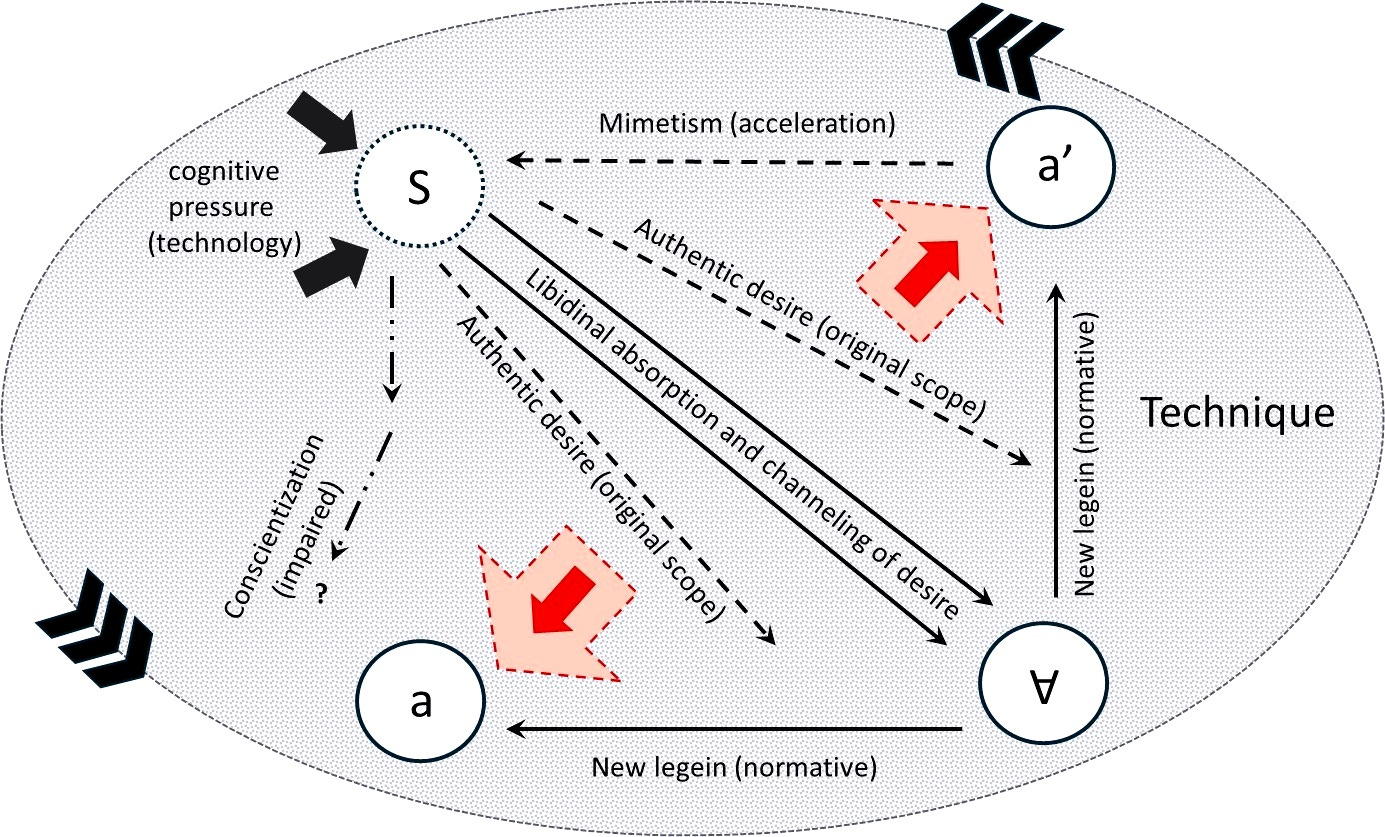
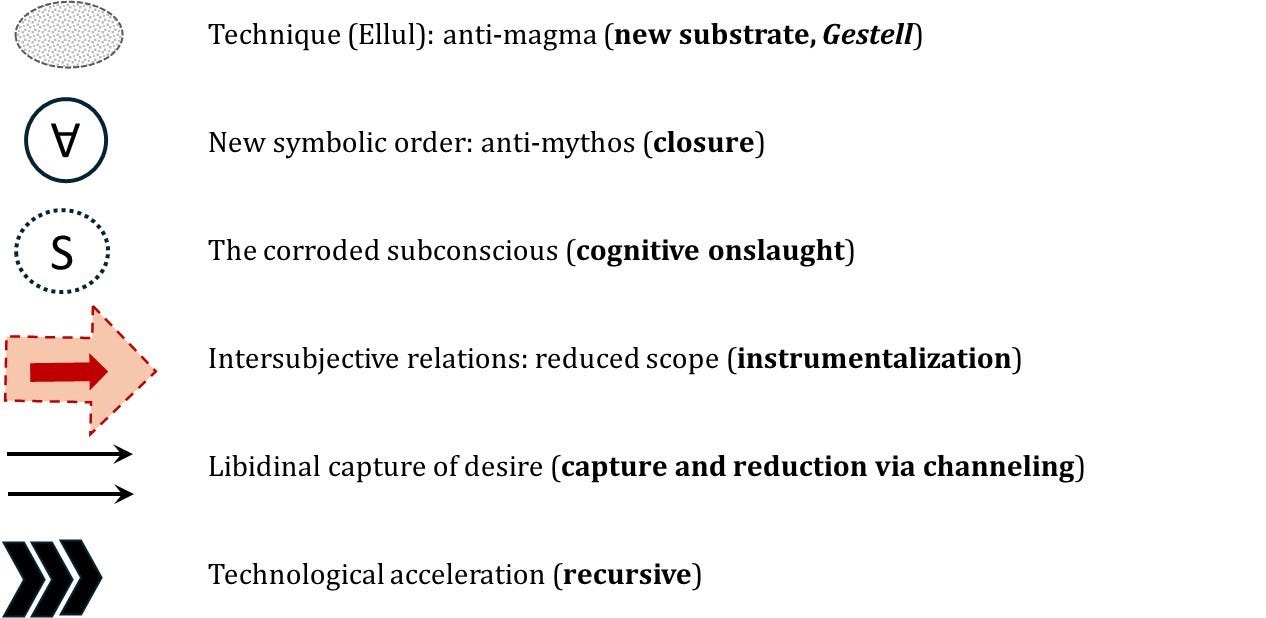
Terms
Technique appears as the substitute of magma in the form of an anti-magma: aiming at a reality that is sleek, without protrusion or frictions, leaving increasingly less room for emergence (and deviation).
Inverted A: this reflects what we said above: the new imaginary is an anti-imaginary, or an anti-myth, which acts as a generator of reductivity (myopic focus on technology and money).
The corroded S: as we explained above, the subconscious subject is corroded by constant technological bombardment (screens, social media, messaging etc.) reducing the space for contemplation and even sleep, where dreams process the reality in an imaginary way. A weakened S.
The reduced intersubjective: the double arrow represents the original or potential scope of intersubjectivity (including friendship, the sharing of common values or collective creativity) and its progressive reduction to narcissistic rivalry, further enhanced by the progressive atomization of society (isolation etc.).
Libidinal capture of desire: in a similar movement to intersubjective relationships, the ineffable and unseizable desire is progressively reduced by an impoverished symbolic order: the progressive disaffection towards too ephemeral ideals, induces what we called a creedal senescence, leaving desire oriented towards increasingly reduced pursuits.
Technological acceleration: again in line with Ellul’s findings, technique engenders technique and accelerates. The problems created by technique call for more technical solutions: it is in this way that technique and technology can be understood as particularly recursive. Likely, the obsessive focus on technological innovations these days (new apps, new updates, new LLMs, new features etc.) tend to accelerate the technification of our existential substrate further.
Implications
Reduction: the reduction of the symbolic order to techno-materialistic pursuits informs social reality: desire and intersubjective relations are curtailed.
Acceleration: the imperatives of technological innovation and economic productivity literally push (or pull) the whole social construct towards inexhaustible acceleration. Petit a and a’ are captured by this phenomenon, lived as increasingly acute economic pressure, which, in turn, further reduces their cognitive horizons: a reductive feedback loop, again.
Anti-legein: The legein propagated by the symbolic order reflects the essence of the latter: it is an anti-legein, driven not by meaning but by techno-economic imperatives, resulting in a anti-use of language, where the newspeak means the contrary of what it says.
Disorientation: all the above results in a disorientation of the subject. While, paradoxically, the entire thanatic schematic L provides a clean, clear libidinal channeling, the subject is the poor relation of the transmutation. The subconscious, cognitively impaired and bombarded, leaves less place for a conscientized emergence into a’s consciousness, further aggravated by a reduction of education levels (reading, counting, thinking), leading to a less formed conscious subject: emotionally (S) and existentially (a) disoriented, but whose libidinal energies are carefully channeled.
Conclusion
Part VI has unveiled the architecture of the techno-capitalist globalizing movement, resulting in an impoverishment of the imaginary that is becoming so radical as to possibly eliminate the possibilities of historical emergence. An accelerating technology which progressively robs people of both their attention and intention, corroding the individual psyche.
As the telos of society is becoming increasingly focused on recursive efficiency - technologically faster, economically cheaper - anthropological fundamentals recede in the background, deprived of their own telos: education (rise of illiteracy, declining reading habits), reproduction (demographic decline verging on collapse), contemplation, all captured, absorbed, marketized and ultimately governed by the new paradigm.
Previous critiques have pointed at the repression of desire - Freud and Marcuse, among others - but their diagnosis still allowed for a survival of desire, which, even repressed, conserved its potential force; the techno-capitalist system functions more insidiously, via a sophisticated, methodical mechanism of libidinal absorption which does not foreclose desire as such, but coerces it within an increasingly tighter funnel, aimed at an increasingly unidimensional ideal: techno-capitalism, or the ultimate form of utilitarianism, without the agency, enacting and enforcing a civilizational death drive on a planetary scale. Thanatos has engulfed Eros, while stealing its vestments: the greatest illusion of our times.
Overture: one last - honest - question.
The diagnosis exposed in this series is theoretical and architectural. The mechanisms and conclusions thereof cannot exclude a question, which runs implicitly through the whole series: the techno-capitalist system, despite its systemic aspect and grip on social reality, cannot be entirely reified. Social considerations, hinted at in part III and above, do play a structural, not only normative role, and invite us to think of the social stratification itself: while techno-capitalism is engulfing and almost all-encompassing, there are actual leaders in this movement: tech moghuls and entrepreneurs, as much as global finance, play a significant role in the transformation we have described, and it begs belief that the direction which is imposed so methodically is entirely unconscious.
As a result, I will propose in the final part VII of this series the following: (1) a contextualization of our findings so far: is the thanatic regime already present a fatality or still a risk model with an increasingly high level of probability of happening as techno-globalism accelerates, (2) while schema L can be read collectively, the collectivity is made up of different social strata which suffer the system in different ways and capacities, calling for a social stratification of it, (3) our pluridialectical framework is fundamentally agnostic, and therefore cannot preclude any future: while the possibilities of historical emergence indeed shrink, could an extra-planar factor kick in and change the dynamics, either from within or without the system, which invites a last consideration (4) the technician system and the technologies are overwhelmingly oriented towards control and quantification: one sizable exception is to mention, even if only potential as of today: space exploration, understood as the expansion of humanity outside earth: for it is clear that such a realization could be seen as an effective and radical historical emergence, possibly changing the rules of an increasingly inflexible game.
Suggested bibliography
Anders, Günther. Die Antiquiertheit des Menschen. Vol. 1. Munich: C. H. Beck, 1956.
Baudrillard, Jean. La Société de consommation: ses mythes, ses structures. Paris: Gallimard, 1970.
Barber, Benjamin R. Consumed: How Markets Corrupt Children, Infantilize Adults, and Swallow Citizens Whole. New York: W. W. Norton, 2007.
Bauman, Zygmunt. Liquid Modernity. Cambridge: Polity Press, 2000.
Bourdieu, Pierre. La Distinction: Critique sociale du jugement. Paris: Éditions de Minuit, 1979. English: Distinction: A Social Critique of the Judgement of Taste. Translated by Richard Nice. Cambridge, MA: Harvard University Press, 1984.
———. La Reproduction: Éléments pour une théorie du système d’enseignement. With Jean-Claude Passeron. Paris: Éditions de Minuit, 1970. English: Reproduction in Education, Society and Culture. Translated by Richard Nice. London: Sage, 1977.
———. Le Capital culturel. Various essays collected in Questions de sociologie. Paris: Éditions de Minuit, 1980.
Castoriadis, Cornelius. L’institution imaginaire de la société. Paris: Éditions du Seuil, 1975. English: The Imaginary Institution of Society. Translated by Kathleen Blamey. Cambridge: Polity Press, 1987.
———. Les carrefours du labyrinthe. 6 vols. Paris: Éditions du Seuil, 1978–1999.
———. Ce qui fait la Grèce. 2 vols. Paris: Éditions du Seuil, 2004–2008.
———. La montée de l’insignifiance. Paris: Éditions du Seuil, 1996.
Debord, Guy. La Société du spectacle. Paris: Buchet-Chastel, 1967.
Han, Byung-Chul. Müdigkeitsgesellschaft. Berlin: Matthes und Seitz, 2010. English: The Burnout Society. Translated by Erik Butler. Stanford: Stanford University Press, 2015.
Heidegger, Martin. “Die Frage nach der Technik.” In Vorträge und Aufsätze. Pfullingen: Günther Neske, 1954.
Girard, René. La Violence et le sacré. Paris: Éditions Bernard Grasset, 1972
Guénon, René. Le Règne de la quantité et les signes des temps. Paris: Gallimard, 1945. English: The Reign of Quantity and the Signs of the Times. Translated by Lord Northbourne. London: Luzac, 1953.
Lacan, Jacques. Le Séminaire, Livre VI: Le désir et son interprétation, 1958–1959. Edited by Jacques-Alain Miller. Paris: Éditions de La Martinière / Le Champ Freudien, 2013.
———. Écrits. Paris: Éditions du Seuil, 1966. English: Écrits: The First Complete Edition in English. Translated by Bruce Fink. New York: W. W. Norton, 2006.
Levinas, Emmanuel. Totalité et Infini: Essai sur l’extériorité. The Hague: Martinus Nijhoff, 1961. English: Totality and Infinity: An Essay on Exteriority. Translated by Alphonso Lingis. Pittsburgh: Duquesne University Press, 1969.
Lasch, Christopher. The Culture of Narcissism: American Life in an Age of Diminishing Expectations. New York: W. W. Norton, 1979.
Lyotard, Jean-François. La Condition postmoderne. Paris: Éditions de Minuit, 1979. English: The Postmodern Condition. Translated by Geoff Bennington and Brian Massumi. Minneapolis: University of Minnesota Press, 1984.
Marcuse, Herbert. Eros and Civilization: A Philosophical Inquiry into Freud. Boston: Beacon Press, 1955.
Pistor, Katharina. The Code of Capital. Princeton: Princeton University Press, 2019.
Prigogine, Ilya, and Isabelle Stengers. La Nouvelle Alliance. Paris: Gallimard, 1979. English: Order Out of Chaos. New York: Bantam Books, 1984.
Stiegler, Bernard. La Technique et le temps. 3 vols. Paris: Galilée, 1994–2001.
Weber, Max. Wirtschaft und Gesellschaft. Tübingen: Mohr, 1922. English: Economy and Society. Edited by Guenther Roth and Claus Wittich. Berkeley: University of California Press, 1978.
Žižek, Slavoj. The Sublime Object of Ideology. London: Verso, 1989.
Castoriadis, Cornelius. (1975) L’insitution imaginaire de la societe. Paris, Seuil. p. 497 (my translation): “We aim at the mode of being of what gives itself before the imposition of the ensemblist or identitary logic: what gives itself as such in this mode of being, we call it magma.” We draw the attention to the reader to the “telluric” definition provided here (lexically, of course, but also symbolically, owing to its pre-structural nature)#.
The claim I am making needs to be further nuanced: modern times have seen countless visionaries appear (wahhabi islam, evangelicalism etc.) and such historical innovations are eminently visionary in nature rather than intellectualized. But the point is that such innovations seem to have been much less influential and in many cases much less durable than their historical predecessors. In addition, all such visions were eminently derivative, i.e. based on existing traditions (Mahdist resurgences, evangelicalism based on Christianity in the first instance etc.). Interestingly, many modern thinkers (Marx, Freud etc.) have often been dubbed prophets, betraying a vocabulary slippage where prophets have become accomplished theoreticians: the description is not entirely abusive, if we consider such thinkers have expanded our vision of reality in some way, but this was the fruit of a long intellectual effort: a far less radical (etymologically understood) imaginary.
Ibid., p.147
Naturally, there are still today cooperatives, family businesses or networks of solidarity which are still alive and well. But the overall, majoritarian trend is unmistakable, and deplored by many an observer these days.
Ibid., p. 414
Ibid., p.18